In August 2026, Parents International returned to Ghana for three days of practical training with school owners, school leaders and our local partner, Parenting Education Network Ghana (PEN Ghana). This report captures not only what happened during the training, but how the programme was shaped by the people taking part.
Rather than relying on lectures or a fixed sequence of content, the facilitators set in motion group activities through which participants shared experiences, compared perspectives, identified challenges and selected the topics they considered most relevant. These priorities then shaped the parallel sessions on Day 2: advocacy and policy change, and critical thinking and information literacy.
The report follows some of the moments that made the training especially meaningful. Participants reworked school mission statements until they converged on two simple ideas: schools where every child is loved, and schools every child loves to attend. A spontaneous exercise in forming groups became a practical lesson in leadership. Work on cognitive bias revealed how difficult it can be to recognise confirmation bias in our own reasoning.
Digital access was not the challenge. Participants had universal access to devices and the internet, and instinctively turned to AI when looking for information and solutions. The more important question was how critically those outputs were checked, questioned and verified — making the information-literacy and critical-thinking elements developed through DRONE particularly relevant.
The advocacy group moved from distinguishing school-level problems from policy problems to mapping decision-makers, identifying those affected, defining a concrete policy change and building a shared advocacy campaign.
Throughout, the report also shows how research developed through EU-funded projects can become practical tools that are adapted to local realities rather than simply transferred from one context to another.
The final day shifted the focus to PEN Ghana and its own strategic priorities, reinforcing a core principle of the Training in Africa Programme: prepare carefully, listen closely, and create the conditions for people to build solutions that work in their own context.
The results of the latest PISA survey were published a few days ago. At times like this, everyone and their dog has something to say about why the results are so dire (and here I could quote from Hungarian, Dutch, German and English press reports from the past few days). The PISA figures always provide a good opportunity to start a discussion about schools – and we certainly must talk about them – but they certainly do not allow us to draw any conclusions about the state of the education system. The fact is, we have no idea what they are measuring; the tests are never made public.
It’s as if we were given a ‘fail’ for our language or maths A-levels, but weren’t allowed to see where we’d gone wrong. Anyone who, like me, works regularly with children can say for sure that students haven’t become any less intelligent. This article, originally published in Hungarian in the ÖT magazine, explores the situation from the perspective of Hungary.
First of all, let’s look at what the figures tell us: surveys conducted in 2022 and 2025 show that 15-year-olds’ reading comprehension, maths and science skills have plummeted worldwide – or at least that is what the results of the undisclosed tests suggest. Compared with 2018, the decline by 2022 was massive, and the situation is similar between 2022 and 2025. This is not just the case for Hungarian children, but in almost every country.
Within this international field, Hungary remained in the middle of the pack, close to the OECD average: in 2022, we were 1 point below the OECD average in maths, 3 points below in reading comprehension, and also 1 point below in science, with the OECD average standing at around 480 points in each area. Compared with Hungary’s 2018 results, there was a decline in mathematics, whilst there was no real change in reading comprehension and science; in other words, Hungary’s relative international position remained essentially unchanged. In 2025, again in line with the international trend, results in maths and reading comprehension deteriorated further, whilst performance in science remained essentially stable.
So one thing is certain: these are not the results we really need to be concerned about. Especially because, as I mentioned, it is impossible to know what the problem actually is.
Two years ago, at the congress of the International Confederation of Principals, I had the opportunity to give a presentation to an audience of over 1,000 headteachers, immediately after Andreas Schleicher, the OECD’s Director for Education and the head of the PISA surveys. On such occasions, we usually send each other the outline of our presentations in advance so that we can respond to one another’s work.
I’ve now taken a look at Andreas’s slides because I remembered that he certainly didn’t emphasise these figures at all. In fact, when we were having dinner together, he confided that they suspect the tests weren’t properly calibrated in 2022. In his presentation, he merely mentioned that while the students were able to answer roughly 60 per cent of the questions correctly, ChatGPT was already achieving a score of around 90 per cent in reading comprehension by the end of 2022. In maths, compared to the children’s 50 per cent score, the AI achieved 60 per cent. And just think how much it has improved since then.
What he did talk about at length, however, were the outcomes beyond the knowledge assessment. He also explained that these are far more important, because the greatest challenge is to ensure that school leavers become lifelong learners who are creative, curious, able to adapt to change and eager to learn. Subject-specific knowledge can be acquired later on. Far more important than the three key indicators are the students’ mental and physical wellbeing, the extent to which they are allowed to take control of their own learning, how resilient they are in times of major change or crisis, and the amount of homework they have versus how much free time they are left with.
He highlighted the fact that 15-year-olds’ creative thinking lags far behind that of 10-year-olds, and that schools do a great deal to stifle this skill, which is now indispensable. Interestingly, whilst girls have long since caught up in terms of subject knowledge, they are far better creative thinkers than boys. Perhaps this is also the reason why their prospects for further education are now much better throughout Europe; even in doctoral programmes, male students are slowly becoming a rarity.
Hungary (together with many other countries) performs poorly in all these areas, so these are the issues we should really be discussing. Hungarian 15-year-olds fall well below average in terms of curiosity, helpfulness and perseverance. At the same time, the proportion of those who believe there is only one correct viewpoint in a debate stands out as particularly high. Far fewer than average are prepared to stand up for something that matters to them, and students find it very difficult to perform under pressure.
Hungary also lags significantly behind more developed countries in the conscious use of digital technology in schools, even though every child already has a smart device by the age of 15. According to OECD data, the use of digital technology for learning purposes has a clearly positive impact on pupils’ marks and other outcomes. However, this requires teachers with advanced digital skills and knowledge, which are certainly in short supply.
A few weeks ago, Francesca Rivafinoli reflected on why it is a problem that Hungarian pupils are overburdened, when pupils in other countries are also struggling. She is right: there are countries with a high number of teaching hours and a lot of homework where PISA scores are better, but we do not know whether this is because of the workload or in spite of it. The usual example of this is Singapore, where children work roughly as much or even more than Hungarian students, whose average school-related working time when they are 15 is around 60 hours.
In Hungary, however, at least the suicide rate is not as high as in that Far Eastern country. Another regular example is Finland, which has performed well for many years in every area – not just in the figures – where the number of teaching hours is very low, homework is banned in primary school and there isn’t much of it in secondary school either.
There are certain regularly mentioned PISA “facts” that have already been disproved. For a long time, for example, it was stubbornly maintained – and education policy documents are still based on this misconception today – that the results of migrant children indicate a serious lack of knowledge. Yes, the hundreds of thousands of Hungarian children attending school in other countries do have results that are below the local average.
However, researchers were given the opportunity to have children attending school in a non-native-language environment sit the test in a language they are comfortable using. And lo and behold, the difference disappeared – it made absolutely no difference whether the children were Polish, Hungarian or Syrian. Only if someone can do the maths test in a language they are proficient in, they can demonstrate what they know.
It is therefore a good thing to discuss schools when the PISA data is published. But until we know why the whole world has received a lower mark than three years ago, it would be worth continuing the discussion on the basis of the other data, rather than the scores in the three knowledge areas. In 2014, more than 80 international education experts and academics wrote an open letter asking the OECD to postpone the next PISA testing cycle and, instead, to launch a comprehensive, democratic consultation, whilst making the tests publicly available and ensuring independent professional scrutiny.
According to the signatories of the petition, before continuing with the assessments, a global consensus should first be reached – involving teachers, parents, labour market stakeholders and researchers – on what the true aims of education are, and indeed what and how it is worth measuring in the interests of students’ development. They also noted that the focus on these three figures has a negative impact on learning. This has never actually happened, but it would be a good thing. It would help us understand what we are reacting to when we analyse the figures.
In the meantime, let’s be glad that whenever the latest PISA data is released, schools always look more important and take centre stage in the media, but let’s always start by acknowledging that the figures don’t really mean anything. I wrote an article on the same subject nearly 10 years ago for the Modern Iskola website (a Hungarian education site). It’s truly sad that nothing has changed since then https://moderniskola.hu/2017/01/pisa-fogyaszthatoan-ketchup-es-sajt-nelkul/
The contribution below is drafted from the perspective of Parents International, drawing on our recent research on digital literacy, digital citizenship, educational ecosystems and the experiences of children, parents, teachers and school leaders.
Our central message is that AI in education must be governed through a comprehensive child-rights framework that recognises children as rights-holders, parents as their primary educators and essential partners, and schools as institutions responsible for creating equitable, inclusive and participatory learning environments.
The contribution also emphasises that AI literacy cannot be developed in isolation from broader digital literacy, critical thinking, democratic participation and the capacity of children and adults to make informed decisions about technology.
Parents International recommends that UNESCO develop practical guidance for the meaningful participation of children and parents in AI governance at system, institutional and school levels.
Such guidance should define minimum standards for consultation, representation, access to information, participation in impact assessments, evaluation and redress, with particular attention to younger children and families traditionally excluded from institutional decision-making.
We further recommend that UNESCO establish a structured mechanism for engaging international parent organisations alongside child-rights organisations, educators, researchers and education authorities in the development, implementation and periodic review of its AI governance recommendations.
Parents International would welcome the opportunity to contribute its research evidence, international network and practical experience in family–school cooperation, digital citizenship education and child-rights-based educational governance to this process.
Consultation context
UNESCO’s consultation concerns the governance of education in the age of AI, with particular attention to human agency, equity, inclusion, safety and ethics. It invites contributions on seven discussion and background papers, including age-appropriate AI use, learner safety, procurement, digital sovereignty and explainability.
The OECD defines the well-being of an individual or a society as comprising two major, complementary pillars. Material conditions constitute the basis of subsistence and economic security. They include income, employment stability, access to decent housing, and the ability to meet essential daily expenses. Quality of life represents the non-economic dimension of life. It focuses on personal and social well-being and encompasses health — both physical and mental — education, including knowledge and skills, and work–life balance, including leisure and time spent with others.
At first sight, all of this may seem easy to achieve, but in practice it is not. Numerous internal and external factors influence these conditions, resulting in profound inequalities within the society in which we live.
The reality before us is shocking. The Global Multidimensional Poverty Index (MPI), developed by the United Nations Development Programme (UNDP) in partnership with the University of Oxford, measures poverty beyond income by assessing daily deprivations in health, education and living standards, such as access to sanitation, electricity and clean drinking water. Approximately 1.1 billion people worldwide live in acute multidimensional poverty. More than half of this total — 584 million people — are children under the age of 18.
These figures stand in stark contrast to those in Capgemini’s World Wealth Report 2026, which states that the number of millionaires increased by 7.9%, reaching a record 25.3 million people. Approximately 2 million individuals entered this category in a single year. The accumulated wealth of this group increased by 8.7%, reaching US$98.3 trillion — the largest annual increase recorded since 2018. In Europe, the millionaire population increased by 6.5%, while in Portugal the number reached 181,000 millionaires, in a country with a population of 10 million.
We are facing an extremely serious problem: every year, poverty increases around the world while extreme wealth also continues to grow. We are witnessing a pattern of economic inequality that has been worsening over recent years.
What kind of balance do we need? From an economic perspective, the ideal balance is often measured using the Gini coefficient — a scale ranging from 0 to 1, where 0 represents perfect equality and 1 represents maximum inequality. A Gini coefficient between 0.25 and 0.35 is considered by many sociologists and economists to represent an ideal balance, as is commonly found in the Nordic countries. It allows people to become wealthier through merit while maintaining a robust social safety net that prevents poverty from spreading.
In short, the ideal balance is achieved when wealth creation functions like a rising tide that lifts all boats — large and small — rather than only the yachts of the wealthiest.
To help minimise this problem, the European Commission established the Fund for European Aid to the Most Deprived (FEAD) in 2014, with an initial allocation of more than €3.8 billion for the 2014–2020 period. European Union Member States supplemented this amount with national co-financing of at least 15% for their respective national programmes.
The Fund was created to help alleviate the most severe forms of poverty in the European Union, including food deprivation, child poverty and homelessness. It provides those most in need with essential items, such as food and basic necessities, including clothing, shoes and personal hygiene products. It also promotes social inclusion through measures such as psychological support and language courses.
To implement the programme, a network was established comprising various organisations and stakeholders, including managing authorities (MAs), partner organisations, other local, regional and national actors, representatives of the European Commission, EU-level partner organisations, the wider EU community, and academic and research organisations. Every year, approximately 13 million people benefit from this Fund.
In 2023, FEAD was integrated into the European Social Fund, and five Communities of Practice were established, focusing on areas such as material support; employment, education and skills; migrant integration; social inclusion; and social innovation, to continue this work.
From the outset, Parents International has followed this project, actively contributing to it and bringing the perspective of parents and families across Europe to the discussion. During the visits organised for us, we had the opportunity not only to meet the organisations working on the ground, but also their beneficiaries.
Through their stories, they told us of their constant struggle for a better life, the dangers they had faced, the barriers imposed upon them, and their immense strength and determination to secure a better future for themselves and their families. Their stories were a profound lesson in life and continue to encourage us to believe that the work carried out by all the organisations actively participating in the programme is not in vain.
This is not easy work. On the one hand, the European Union provides funding and encourages its Member States to eradicate poverty. On the other hand, certain countries, whose governments pursue ineffective economic policies and implement cuts to social provision, actively contribute to perpetuating this enormous scourge.
In a world where wealth grows alongside poverty, it is the organisations working on the ground that, despite setbacks, shortages and exhaustion, transform solidarity into resistance and dignity into a future worth fighting for.
What kind of Europe do we want to build for future families on this foundation?
Herminio Corrêa Member of the Parents International Supervisory Board
It is one of those phrases we repeat so often that we rarely stop to ask an obvious question: what if you don’t have a parenting village?
For many families today, the traditional image of the “village” bears little resemblance to everyday life. Grandparents may live hundreds or thousands of kilometres away. Families move for work, education or simply in search of a better life. Neighbours may know each other well enough to say “hello”, but not well enough to call when you need someone to watch your child for half an hour. Friends juggle their own children, jobs, and responsibilities.
At the same time, parenting seems to have become more demanding, not less.
Parents are expected to understand child development, nutrition, emotional regulation, online safety, social media, artificial intelligence, bullying, mental health, education, sleep, relationships and countless other aspects of their children’s lives. We are told to be present, patient and emotionally available while also raising independent and resilient children.
And very often, we are expected to do all of this within the walls of one household.
The parenting village was never just about childcare
When we talk about needing a village, it is easy to think primarily about practical help: someone who can pick a child up from school, bring over dinner or babysit.
That matters enormously. But a village offers something else, too.
Children benefit from having meaningful relationships with adults other than their parents. They need grandparents, relatives, family friends, neighbours, coaches, professional educators and other trusted adults who see them in different contexts and offer different perspectives.
Parents need those relationships too.
Sometimes we need someone who knows our child well enough to say, “I’ve noticed that too.” Sometimes we need someone to reassure us that a difficult phase really is a phase. Sometimes we need advice. Sometimes we need practical help. And sometimes we simply need another adult who understands why we are exhausted.
A village distributes not only the work of raising children, but also some of its emotional weight.
We cannot recreate a village that no longer exists
There is a temptation to romanticise the past. Families once lived closer together. Children played outside with neighbours. Grandparents helped. Communities looked after their own.
Some of that is true for some families, and some of it was probably never quite as idyllic as we remember it.
More importantly, telling families that they have lost something does not help them very much.
The realities of modern family life are unlikely to disappear. People will continue to move between cities and countries. Families will take many different forms. Grandparents will not always live nearby, or be able, or willing, to provide childcare. Parents will keep building friendships and communities both online and offline.
Perhaps, then, the question is not how we get the old village back.
It is how we build a new one.
Building your own village
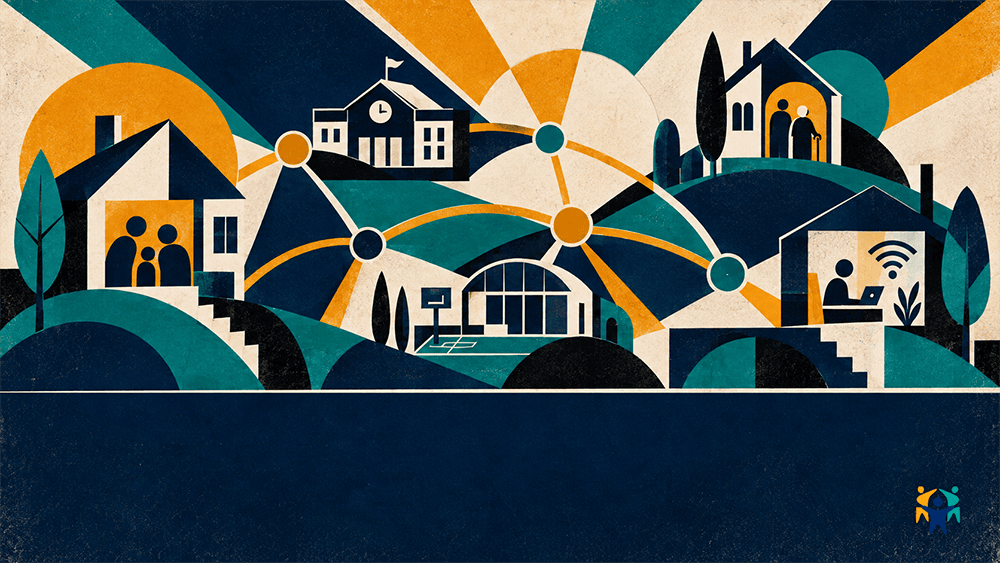
A modern village may look very different from the one imagined in the familiar proverb.
It might include a grandparent who reads a bedtime story over a video call from another country. It might be another parent who can collect your child from school when a meeting runs late. It might be a neighbour your child knows they can approach if they need help.
It can include the teacher who really knows your child, the sports coach who notices when something is wrong, the family friend who has been around for years, or the parents you met because your children happened to become friends.
And yes, parts of that village may be digital.
Online communities are often dismissed as poor substitutes for “real” relationships. Sometimes they are. But they can also connect parents who would otherwise be profoundly isolated: parents of children with particular needs, families living far from relatives, multilingual and multicultural families, single parents, or simply someone awake with a baby at three in the morning wondering whether anybody else is finding this as difficult as they are.
The modern village does not have to be defined by geography.
It is defined by relationships, trust and reciprocity.
A village cannot be another job for parents.
There is, however, a danger in telling parents to “build their parenting village.”
It can easily become one more responsibility added to an already very long list.
If families are isolated, the answer cannot simply be to tell individual parents that they should network better.
Communities and institutions have a role in making relationships possible. Schools, community organisations, municipalities, family services, libraries, sports clubs and other spaces around children can either create opportunities for families to meet one another or make every interaction purely transactional.
A school event, for example, can be designed simply to transmit information to parents. Or it can also create opportunities for families to talk to one another and form relationships.
A neighbourhood can contain hundreds of families without creating a community between them.
If we believe that children benefit from strong communities, then creating the conditions for those communities to develop should not rest entirely on parents.
Children need a village of their own
There is another reason why rebuilding the village matters.
Children gradually need a world that extends beyond their parents.
As they grow, they need other people they trust. They need adults they can turn to when, for whatever reason, talking to a parent feels difficult. They need relationships in which they can discover different interests, perspectives and ways of living.
This does not diminish the role of parents. Quite the opposite.
Part of raising an increasingly independent child is helping them build a network of safe, meaningful relationships around themselves.
Perhaps one of the most valuable things we can give our children is not the promise that we will always be able to solve everything for them, but the knowledge that they will never have only one person to turn to.
A different kind of village
The village around today’s family may be scattered across cities, countries and screens. It may include relatives, friends, professionals and people we met only because our children brought us together.
It may require more deliberate effort to create than the communities previous generations inherited automatically.
But perhaps that makes it no less real.
The challenge for families of tomorrow is not to recreate an idealised past. It is to recognise that raising children has always been a relational task and to find new ways of creating those relationships in the world we actually live in.
Because it still takes a village to raise a child. We may simply have to build ours differently.