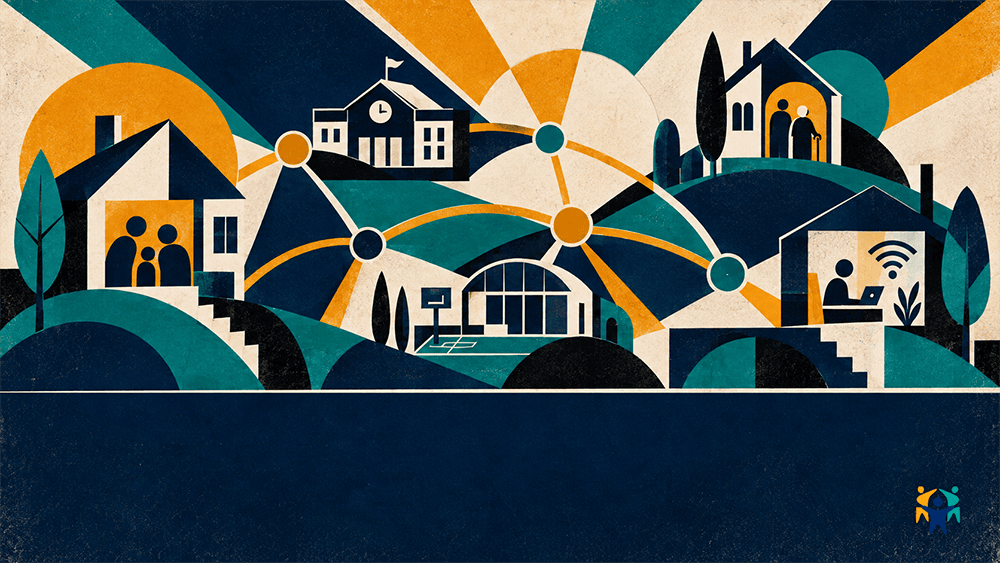
“It takes a village to raise a child.”
It is one of those phrases we repeat so often that we rarely stop to ask an obvious question: what if you don’t have a parenting village?
For many families today, the traditional image of the “village” bears little resemblance to everyday life. Grandparents may live hundreds or thousands of kilometres away. Families move for work, education or simply in search of a better life. Neighbours may know each other well enough to say “hello”, but not well enough to call when you need someone to watch your child for half an hour. Friends juggle their own children, jobs, and responsibilities.
At the same time, parenting seems to have become more demanding, not less.
Parents are expected to understand child development, nutrition, emotional regulation, online safety, social media, artificial intelligence, bullying, mental health, education, sleep, relationships and countless other aspects of their children’s lives. We are told to be present, patient and emotionally available while also raising independent and resilient children.
And very often, we are expected to do all of this within the walls of one household.
The parenting village was never just about childcare
When we talk about needing a village, it is easy to think primarily about practical help: someone who can pick a child up from school, bring over dinner or babysit.
That matters enormously. But a village offers something else, too.
Children benefit from having meaningful relationships with adults other than their parents. They need grandparents, relatives, family friends, neighbours, coaches, professional educators and other trusted adults who see them in different contexts and offer different perspectives.
Parents need those relationships too.
Sometimes we need someone who knows our child well enough to say, “I’ve noticed that too.” Sometimes we need someone to reassure us that a difficult phase really is a phase. Sometimes we need advice. Sometimes we need practical help. And sometimes we simply need another adult who understands why we are exhausted.
A village distributes not only the work of raising children, but also some of its emotional weight.
We cannot recreate a village that no longer exists
There is a temptation to romanticise the past. Families once lived closer together. Children played outside with neighbours. Grandparents helped. Communities looked after their own.
Some of that is true for some families, and some of it was probably never quite as idyllic as we remember it.
More importantly, telling families that they have lost something does not help them very much.
The realities of modern family life are unlikely to disappear. People will continue to move between cities and countries. Families will take many different forms. Grandparents will not always live nearby, or be able, or willing, to provide childcare. Parents will keep building friendships and communities both online and offline.
Perhaps, then, the question is not how we get the old village back.
It is how we build a new one.
Building your own village
A modern village may look very different from the one imagined in the familiar proverb.
It might include a grandparent who reads a bedtime story over a video call from another country. It might be another parent who can collect your child from school when a meeting runs late. It might be a neighbour your child knows they can approach if they need help.
It can include the teacher who really knows your child, the sports coach who notices when something is wrong, the family friend who has been around for years, or the parents you met because your children happened to become friends.
And yes, parts of that village may be digital.
Online communities are often dismissed as poor substitutes for “real” relationships. Sometimes they are. But they can also connect parents who would otherwise be profoundly isolated: parents of children with particular needs, families living far from relatives, multilingual and multicultural families, single parents, or simply someone awake with a baby at three in the morning wondering whether anybody else is finding this as difficult as they are.
The modern village does not have to be defined by geography.
It is defined by relationships, trust and reciprocity.
A village cannot be another job for parents.
There is, however, a danger in telling parents to “build their parenting village.”
It can easily become one more responsibility added to an already very long list.
If families are isolated, the answer cannot simply be to tell individual parents that they should network better.
Communities and institutions have a role in making relationships possible. Schools, community organisations, municipalities, family services, libraries, sports clubs and other spaces around children can either create opportunities for families to meet one another or make every interaction purely transactional.
A school event, for example, can be designed simply to transmit information to parents. Or it can also create opportunities for families to talk to one another and form relationships.
A neighbourhood can contain hundreds of families without creating a community between them.
If we believe that children benefit from strong communities, then creating the conditions for those communities to develop should not rest entirely on parents.
Children need a village of their own
There is another reason why rebuilding the village matters.
Children gradually need a world that extends beyond their parents.
As they grow, they need other people they trust. They need adults they can turn to when, for whatever reason, talking to a parent feels difficult. They need relationships in which they can discover different interests, perspectives and ways of living.
This does not diminish the role of parents. Quite the opposite.
Part of raising an increasingly independent child is helping them build a network of safe, meaningful relationships around themselves.
Perhaps one of the most valuable things we can give our children is not the promise that we will always be able to solve everything for them, but the knowledge that they will never have only one person to turn to.
A different kind of village
The village around today’s family may be scattered across cities, countries and screens. It may include relatives, friends, professionals and people we met only because our children brought us together.
It may require more deliberate effort to create than the communities previous generations inherited automatically.
But perhaps that makes it no less real.
The challenge for families of tomorrow is not to recreate an idealised past. It is to recognise that raising children has always been a relational task and to find new ways of creating those relationships in the world we actually live in.
Because it still takes a village to raise a child. We may simply have to build ours differently.
More from Parents International
Behind the bans: the infantilisation of parenthood
TOURIST, HOUSEMAID OR NANNY? A GRANDPARENT’S GUIDE TO VISITING

