In this Article
UNESCO symposium on the future of the right to education
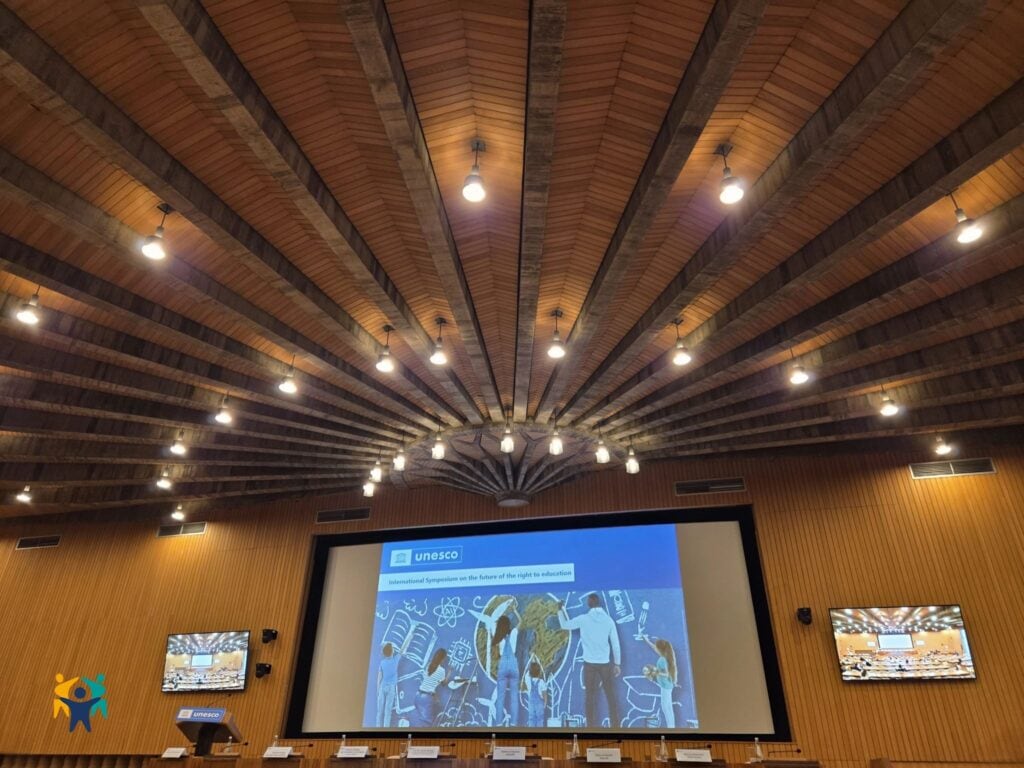
The last 2025 event Parents International was represented at was a high-level symposium at the Paris headquarters of UNESCO on the future of the right to education. Representatives of governments from all over the world, key stakeholder representatives and international organisations working in the field of education and child rights gathered to discuss the implications of the freshly launched report “The right to education – Past, present and future directions“.
Participants all believe that education is one of the most powerful drivers of societal progress, social cohesion, and individual development, and that the right to education is at a pivotal crossroads. The report takes stock of 25 years of advancement in realizing that right, documenting significant achievements including the near-universalization of primary schooling, the expansion of formal learning opportunities from early childhood to higher education, and the increasing recognition of lifelong learning as a foundation for human and social development.
At the same time, profound changes in how we live, work, and learn have placed education systems under intense pressure to evolve rapidly. The report examines how digitalization, conflict, migration, and demographic shifts are reshaping the landscape of the right to education, with particular implications for vulnerable populations.
In the spirit of the 2015 UNESCO publication Rethinking education: towards a global common good?,it calls for renewed global commitment – not only by state actors and not only in the formal education system – to strengthening the legal and institutional underpinnings of the right to education, addressing persistent inequities, and preparing systems for emerging demographic, technological, and societal challenges.
Progress, pressure and the future of the Right to Education
Participants agreed that education can only continue to serve as both a protective and transformative force for all if all these dimensions are reinforced.
It was a welcome feature of the event that the role of parents and the need to support them as educators was emphasised by many. Most of the speakers highlighted the importance of having a holistic view on education, and acknowledging that formal education is only a part of educational journeys with non-formal and informal education being often far more impactful on the learning of a person. A major emphasis was on the need for people to become lifelong learners – and that it requires students to remain open and curious.
The only disappointing part of the event was the final panel where the representative of France, the only developed country where religious Muslim girls and Jewish boys are excluded from public education talked about the importance of accessible and inclusive public education, and the representative of Mauritania said “education is classroom, students and teachers” after a full day of discussing it is not.
The global learning crisis, flagged by the World Bank back in 2018, was mentioned multiple times. The situation has only worsened with a growing percentage of children attending school and not acquiring basic reading, writing and numeracy skills. Access to school has improved, school is nearly universally available to all primary aged children, but the number of children out of school, often as a conscious parental decision is growing. This is something we have been highlighting since 2020 through our involvement in the Worldwide Commission to Educate All Kids.
Parents International, relevance of school, and repairing education ecosystems
Another key issue raised by many – very much in line with what we have been advocating for – is the decreasing relevance of school curricula and the need to renew them to make school relevant and attractive again. We are definitely not doing well here. Recent research shows that while 2 to 5 year old children may ask an average of 107 questions per hour when they are awake, this goes down to a maximum 2 after starting school. We also see from our own research and talking to parents that schools cannot yet provide for education in crucial current areas such as digital literacy.
We got a lot of food for thought, and also valuable global data that tells us that the Parents International team is working on very topical issues. It is also clear that our advocacy for being precise and careful when using certain phrases is important. It is clear that the currently broken education ecosystems can only be repaired if we don’t mean schooling only when mentioning education, and we don’t only mean teachers when saying educators. This closing event of the busy and productive year of 2025 set the tone and gave us motivation for 2026.
More from Parents International
Reimagining Schools as Living Ecosystems
Let’s make the New Education Deal a reality now
How to save a generation nearly lost due to bad policies?
Parents as Educators for Global Literacy Solutions
Parental Engagement: Listening First, Partnering Always